
- The problem
- India’s 63M+ MSMEs can’t afford HR staff or HR software, and their multilingual workforces make payroll, compliance and training hard.
- What I did
- Interviewed business owners and workers, mapped the competition (TOWS, Porter’s Five Forces, feature table), and turned the insights into solution concepts and personas.
- Outcome
- VernaHR: a simple, affordable, multilingual HR app concept with a phased roadmap from MVP to launch in about 11 months.
Background research
India is home to over 63 million Micro, Small and Medium Enterprises, which account for over 45% of the country's industrial output and 40% of its exports. However, these businesses often face significant challenges when it comes to human resources.
| Activity Category | Estimated no. of Rural Enterprises (in lakh) | Estimated no. of Urban Enterprises (in lakh) | Estimated no. of Total Enterprises (in lakh) | Share (%) |
|---|---|---|---|---|
| Manufacturing | 114.14 | 82.5 | 196.65 | 31 |
| Electricity* | 0.03 | 0.01 | 0.03 | 0 |
| Trade | 108.71 | 121.64 | 230.35 | 36 |
| Other Services | 102 | 104.85 | 206.85 | 33 |
| All | 324.88 | 309 | 633.88 | 100 |
*Non-captive electricity generation and transmission
(Source: Indian Govt. MSME Annual Report 2022-23)
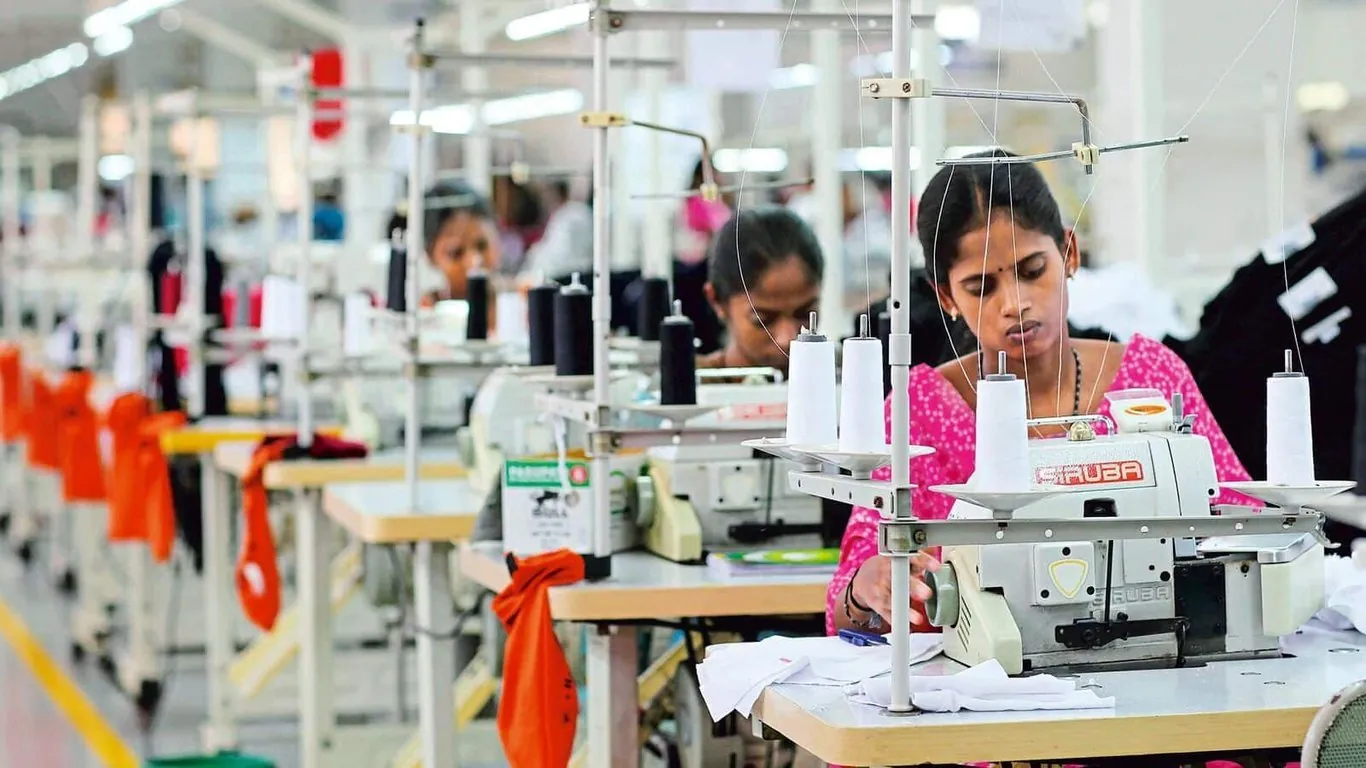
One of the biggest challenges is that MSMEs often have limited resources and expertise. They may not have the time or the budget to hire a full-time HR professional, or to invest in expensive HR software. As a result, they may struggle to keep up with the latest HR trends and best practices.
Another challenge is that MSMEs often have a diverse workforce, with employees from different backgrounds and speaking different languages. This can make it difficult to manage HR tasks such as payroll, compliance, and employee training.
MSMEs often operate in a rapidly changing business environment. This means that they need to be able to adapt their HR policies and practices quickly. However, it can be difficult for them to do this without the right tools and support.
The Goal
User Research
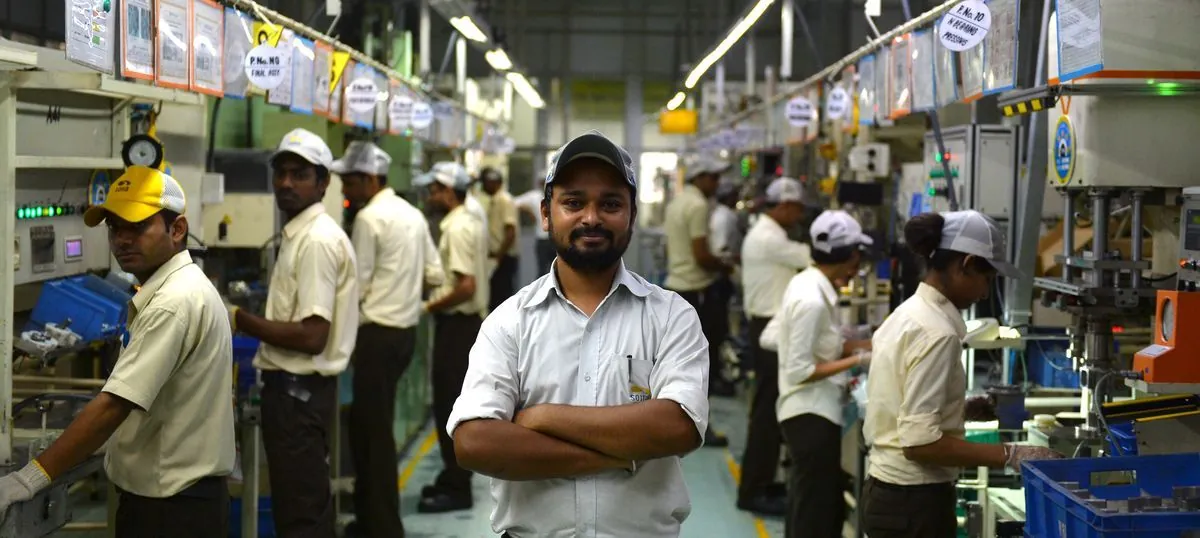
My interviews focussed on Business Owners, MSME workers, which forms the largest demographic, and would also be the target users for the solution being developed.
The following insights were discovered.
Insight A
Users consistently emphasised the importance of simplicity and ease of use in HR software. They seek a solution that doesn't require extensive training and is intuitive, allowing even non-technical personnel to manage HR tasks efficiently.
Insight B
Affordability emerged as a top concern for both business owners and MSME workers. They require a cost-effective HR management platform that doesn't strain their budgets, making it accessible to a broader audience.
Insight C
The demand for multiple regional languages support was a prevalent theme among our interviewees. Users stressed the significance of being able to operate the platform in their preferred language, facilitating better understanding and engagement with HR processes.
Vision
Competitive Landscape
TWOS Analysis - Understanding our Product
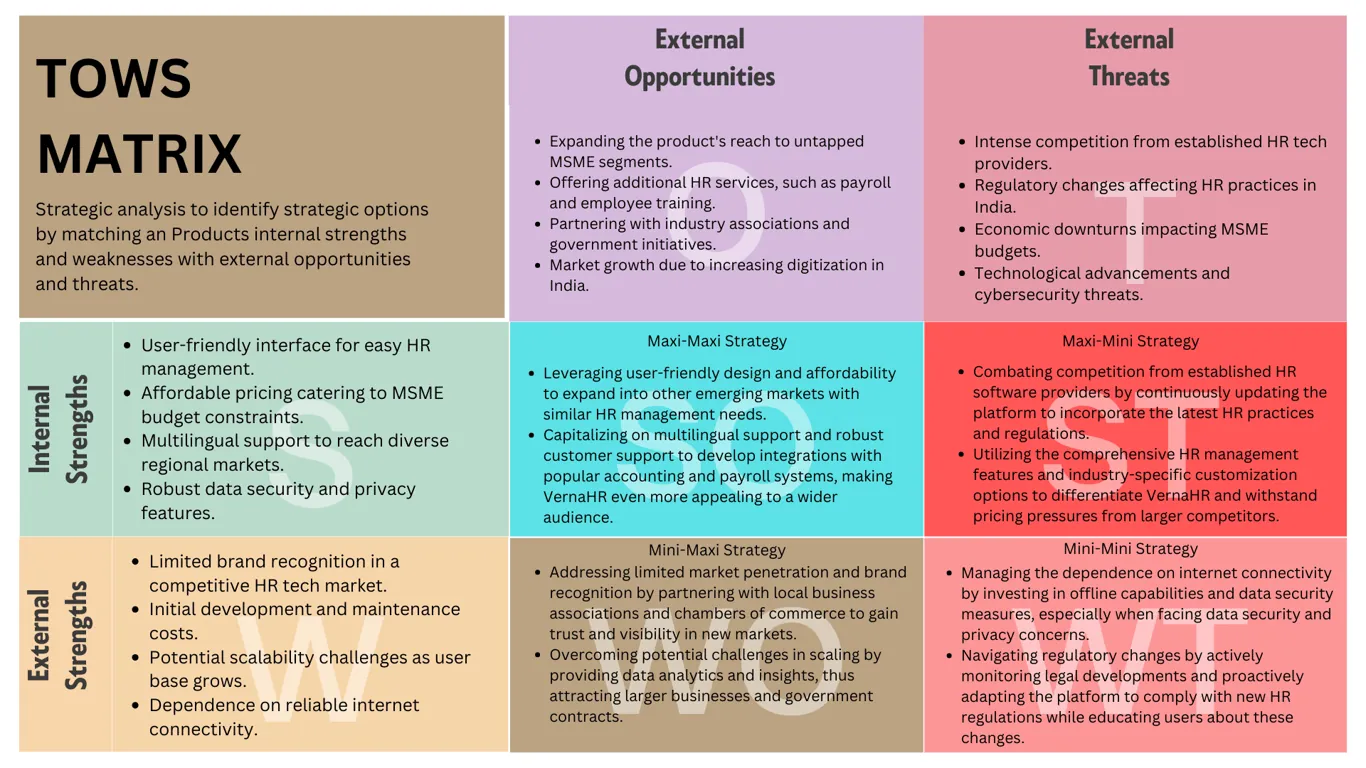
- Maxi-Maxi Strategy:
- Objective: Leverage internal strengths to capitalise on external opportunities.Focus: Utilise resources for maximum advantage in favourable conditions.
- Maxi-Mini Strategy:
- Objective: Maximize internal strengths while minimising external threats.Focus: Harness strengths to mitigate potential risks and threats.
- Mini-Maxi Strategy:
- Objective: Minimising internal weaknesses while maximising external opportunities.Focus: Improve internal weaknesses by taking advantage of available opportunities.
- Mini-Mini Strategy:
- Objective: Minimising both internal weaknesses and external threats.Focus: Highly defensive approach, prioritising risk avoidance and mitigation.
Porters 5 Forces - Understanding competition in the Market
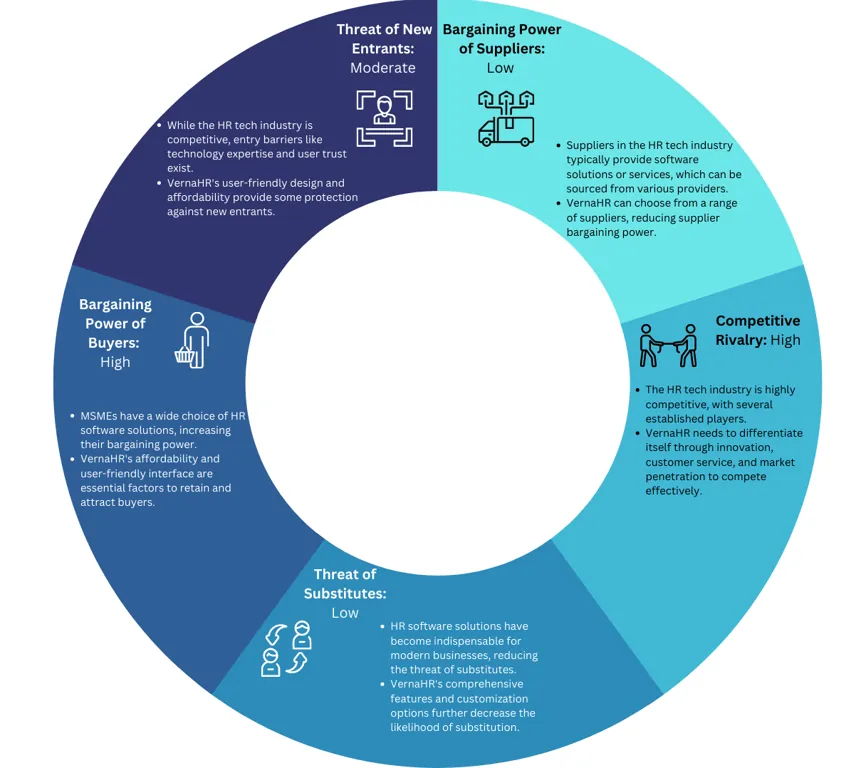
Porter's Five Forces is a framework used to analyze the competitive forces in an industry and assess its attractiveness. It helps businesses understand:
- Threat of New Entrants: How easy it is for new competitors to enter the market.
- Bargaining Power of Suppliers: The influence suppliers have on pricing and quality.
- Bargaining Power of Buyers: The influence customers have on pricing and terms.
- Threat of Substitutes: The availability of alternative products or services.
- Competitive Rivalry: The intensity of competition within the industry.
We use this analysis to make informed decisions about strategy, identify opportunities, and manage risks in their industry.
Feature Table - Understand about the competitor products
| Feature | Zoho People | Beehive HRMS | Keka | GreytHR | Pocket HRMS | Saral PayPack |
|---|---|---|---|---|---|---|
| Core HR | Yes | Yes | Yes | Yes | Yes | Yes |
| Payroll | Yes | Yes | Yes | Yes | Yes | Yes |
| Performance management | Yes | Yes | Yes | Yes | Yes | Yes |
| Talent management | Yes | Yes | Yes | Yes | Yes | Yes |
| Time and attendance | Yes | Yes | Yes | Yes | Yes | Yes |
| Leave management | Yes | Yes | Yes | Yes | Yes | Yes |
| Self-service portal | Yes | Yes | Yes | Yes | Yes | Yes |
| Mobile app | Yes | Yes | Yes | Yes | Yes | Yes |
| Integrations | Yes | Yes | Yes | Yes | Yes | Yes |
| Offline Setup and Support | No | No | No | No | No | No |
| Mobile app/Website with multiple language usage | No | No | No | No | No | No |
| Pricing | Starts at $15/month | Starts at $9/month | Starts at $99/month | Starts at ₹10,000/month | Starts at ₹12,000/month | Starts at ₹9,999/month |
Solution Concepts
Related to Insight A
- Develop an intuitive, user-friendly interface with a minimal learning curve.
- Provide comprehensive onboarding and training resources to ensure even non-technical users can efficiently manage HR tasks.
Related to Insight B and ST
- Offer tiered pricing plans to cater to the budget constraints of different MSMEs.
- Implement a competitive pricing strategy that ensures affordability without compromising quality or features to withstand competitive pressures.
Related to Insight B and WO1
- Collaborate with local business associations and chambers of commerce to offer special discounts or promotions for members.
- Leverage these partnerships to expand your market presence and gain trust among potential customers.
Related to Insight C and SO2
- Integrate translation and localization features into the platform to support multiple regional languages.
- Use the multilingual advantage to explore new markets in regions with diverse language preferences, aligning with the SO strategy.
Related to Insight A and ST2
- Continuously update the platform to align with the latest HR regulations and industry best practices.
- Offer industry-specific customization options to cater to the unique needs of different businesses, giving VernaHR a competitive edge.
Related to Insight C and SO1
- Collaborate with local experts or consultants who can assist with the platform's implementation and usage in specific regions.
- Use these partnerships to enter new markets smoothly, in line with the SO strategy.
User Personas
User Persona 1: HR Manager in an MSME
Name: Priya Sharma
Background:
- Age: 32
- Education: MBA in Human Resources
- Job Role: Priya is an HR manager responsible for managing HR processes in an MSME with 150 employees. She has a strong understanding of HR practices and is tech-savvy.
- Tech Proficiency: Proficient in using various HR software and tools.
Challenges:
- Balancing multiple HR tasks, including recruitment, onboarding, and employee relations.
- Ensuring compliance with labor laws and regulations.
- Seeking ways to improve HR efficiency and reduce administrative tasks.
Goals:
- Streamline HR processes to save time and reduce manual work.
- Improve employee engagement and satisfaction.
- Stay updated on HR trends and best practices.
Product Roadmap
User Persona 2: MSME Worker
Name: Sunita Devi
Background:
- Age: 30
- Education: High school graduate
- Occupation: Sunita works as a machine operator in a small textile factory in a rural area. She has limited knowledge of English and primarily communicates in her regional language.
- Tech Proficiency: Basic smartphone usage for communication and basic tasks.
Challenges:
- Struggles to understand and use HR software due to a lack of English proficiency.
- Finds it challenging to access and update HR-related information.
- Requires a platform that supports her regional language.
Goals:
- Easily access and update personal HR information.
- Receive notifications and alerts related to her employment.
- Communicate with HR and access essential HR resources in her regional language.
Preparatory Phase
Before Sprint 1, a critical preparatory phase will occur. This includes product feature selection, environment choice (database and cloud provider), development planning, wire-framing, and UI/UX design. This phase sets the foundation and direction for subsequent sprints, ensuring a well-structured development process.
Each sprint will last for a duration of 2 weeks.
| Task | Timeline |
|---|---|
| Product Feature Selection | Months 1 |
| Environment Selection, Development Planning and Wire-framing | Months 2 |
| UI/UX Design | Months 3 |
| MVP Launch | Months 4-7 |
| Improvements and Final Product Launch additions | Months 8-10 |
| Product Launch | Month 15 |
| CI and Support | Month 15 and Beyond |
MVP Launch (Months 4 - 7)
| Sprint | Activities |
|---|---|
| Sprint 1 | • Design user interface for Employee Onboarding. • Develop basic database structure for Employee Database Management. • Begin initial work on Attendance via Biometric scanning. |
| Sprint 2 | • Develop core functionality for Employee Onboarding. • Continue building the Employee Database Management system. • Initiate HR Files management module. • Begin Employee Self-Service development. |
| Sprint 3 | • Complete Employee Onboarding module. • Enhance Employee Database Management with search and basic reporting. • Continue HR Files management development. • Initiate Time Off Management. |
| Sprint 4 | • Implement Attendance via Biometric scanning. • Enhance Employee Self-Service with essential features. • Begin Module-based Reports development. |
| Sprint 5 | • Develop core features for HR Files management. • Continue Module-based Reports development. • Start Workflow Management module. |
| Sprint 6 | • Begin Timesheet Management for employee app and website. • Enhance Workflow Management with basic approval functionality. • Start multilingual support development. |
| Sprint 7 | • Finalize Timesheet Management for both employee app and website. • Complete Workflow Management with advanced features. • Continue multilingual support development. |
| Sprint 8 | • Extensive testing of the MVP features. • Bug fixing and performance optimization. • Prepare for MVP launch. |
Improvements and Final Product Launch (Months 8 - 11)
| Sprint | Activities |
|---|---|
| Sprint 9 | • Collect user feedback from MVP launch. • Analyze usage data to identify improvements. • Begin development of Learning and development module. |
| Sprint 10 | • Enhance Employee engagement module. • Start Talent management module development. • Implement minor improvements based on MVP feedback. |
| Sprint 11 | • Continue developing Learning and development, Talent management, and Employee engagement modules. • Refine user interface based on feedback. |
| Sprint 12 | • Complete development of additional HR features. • Integrate new features into the platform. • Initiate beta testing with select users. |
| Sprint 13 | • Extensive testing of the final app, including new features and multilingual support. • Bug fixing and security audits. |
| Sprint 14 | • Refine the user interface, ensuring seamless multilingual support. • Prepare for the final app launch, including marketing strategies. |
| Sprint 15 (Launch) | • Launch the final app with a comprehensive feature set, including Learning and development, Talent management, Employee engagement, and HR analytics. • Begin post-launch support and continuous improvements. |
| Sprint 16 and beyond | • Ongoing post-launch support, user feedback analysis, and regular updates. • Continuous improvement based on evolving industry trends and user needs. |
Final thoughts
The HR Tech product, VernaHR, is a comprehensive solution designed for SMEs and MSMEs in India. The vision behind VernaHR is to provide an intuitive, user-friendly, and affordable platform that caters to the specific needs of businesses in India. The product roadmap outlines a phased approach, starting with an MVP launch focused on essential HR features and multilingual support. Prior to development, a critical preparatory phase includes feature selection, environment assessment, development planning, wire-framing, and UI/UX design. It's important to note that the product development process, including wireframes and other steps, will be executed in a phased manner. This well-structured approach ensures that VernaHR meets the unique HR needs of Indian businesses while continuously evolving to provide value and support for their growth. The journey continues with post-launch support, user feedback analysis, and ongoing improvements, ensuring the product's relevance and effectiveness in the dynamic HR tech landscape.